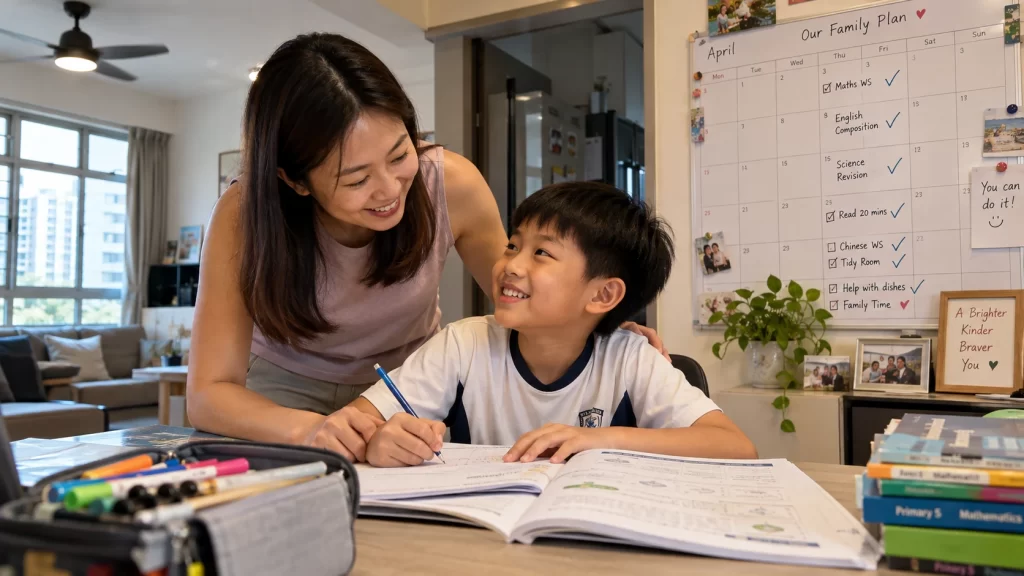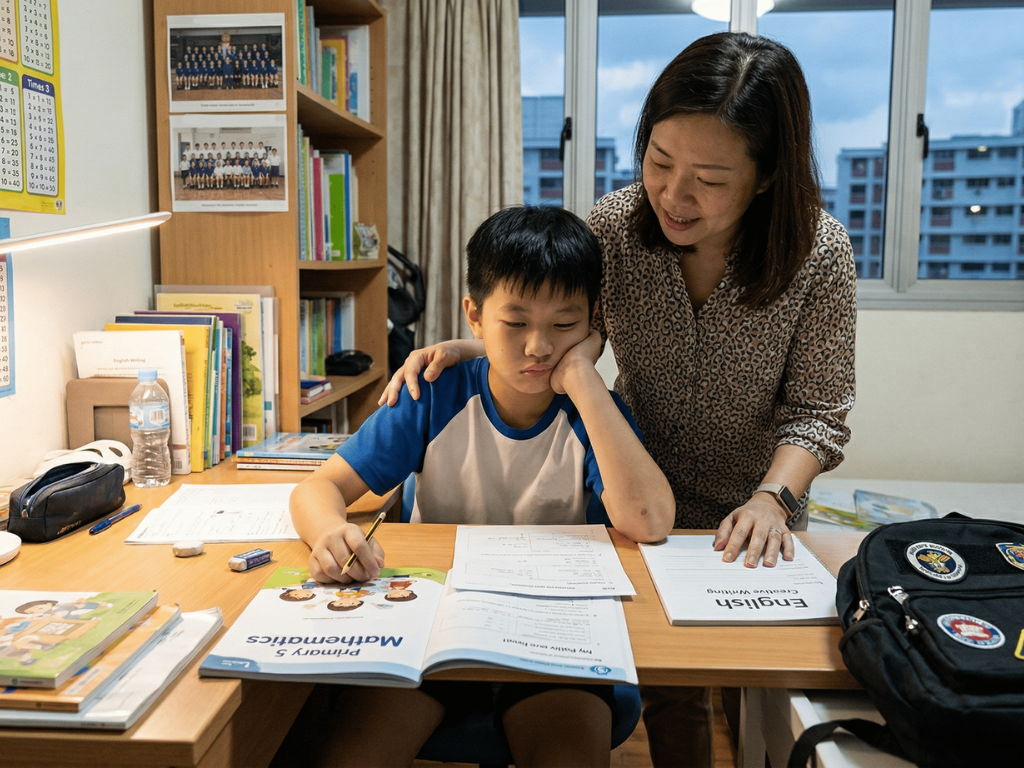
It is 4 pm. The school bag is open. The homework is on the table. And your child looks at you with the expression of someone being asked to climb Everest barefoot.
“I don’t want to study!” Four words most parents of primary school children know intimately. Delivered with a dramatic groan, a full-body slump, or the sudden discovery of an urgent need to do something, anything else.
Homework battles are exhausting. They strain the parent-child relationship, turn evenings into standoffs, and leave everyone frustrated and depleted. And the more you push, the harder your child pushes back.
Here is what most parents do not realise: pushing harder rarely works. For many children, it actively makes things worse.
The key is not force. It is understanding. Understanding why your child is resisting and responding in a way that builds motivation rather than breaking it. This article walks through five proven strategies to turn homework battles around, for good.
Way 1: Understand the Root Cause Before You React
The most important step is the one most parents skip: finding out why your child does not want to study.
“I don’t want to” is rarely the whole story.
The Hidden Reasons Behind Homework Refusal
Children resist homework for very different reasons, and the response that works for one can make things dramatically worse for another.
- The work is too hard. Your child does not understand the material and does not know how to say so. Resistance becomes the easier option.
- They are exhausted. After six-plus hours of school, 30 minutes of travel, and the emotional weight of a full social day, some children genuinely have nothing left. Their brain needs rest before they can absorb anything new.
- They are anxious. In Singapore’s academically demanding environment, many children, even high achievers, develop a deep fear of making mistakes. Homework becomes a high-stakes performance, not a learning exercise. Avoidance is self-protection.
- They are bored. Bright children who find the work too easy can be just as resistant as those who find it too hard. Disengagement looks the same from the outside.
- It has become a power struggle. When homework has been a consistent battleground, some children resist simply because resisting feels like the one thing they can control.
How to Find Out What Is Really Going On
- Ask, do not tell. Instead of “Sit down and do your homework now,” try “What feels hard about starting?” or “Is there anything about today’s work that’s worrying you?”
- Listen without immediately problem-solving. Sometimes a child simply needs to say “I don’t understand fractions” without being immediately redirected to a textbook. The act of being genuinely, unhurriedly heard can itself dissolve a surprising amount of resistance.
- Watch the pattern. Is the resistance specific to one subject? One type of task? A particular time of day? Patterns reveal causes, and causes point to solutions.
- Consider the timing. A child who fights homework at 5 pm but would happily complete it at 7 pm after dinner is telling you something important about their energy and recovery needs. Flexibility here is not permissiveness; it is strategy.
The right response to homework resistance depends entirely on the right diagnosis. A tired child needs rest. An anxious child needs reassurance. A confused child needs support. Treating them all the same way solves nothing.
Way 2: Shift the Focus From Grades to Effort and Progress
One of the most damaging things a parent can do entirely without meaning to is make their child feel that homework is a performance review.
When a child believes that a wrong answer reflects something permanent about their intelligence, avoiding homework becomes a rational act of self-protection. Why risk proving that you are not good enough?
Introduce the Power of a Growth Mindset
Stanford psychologist Carol Dweck’s decades of research reveal something profound: children who believe their abilities can grow through effort are more persistent, more willing to attempt difficult tasks, and significantly less likely to resist homework.
The shift is simple in principle, though it takes consistent practice. Help your child understand that the brain is a muscle. Every time they struggle with something hard and keep going, they are making it stronger. Every mistake is not a mark against them; it is evidence that they are learning.
Change the Language of Praise
The words parents use carry extraordinary weight:
- Instead of “You’re so clever!” Try the following: “I love how hard you worked on that.”
- Instead of “Why did you get that wrong?” Try the following: “What do you think you could try differently next time?”
- Instead of “Just get it done”, Try the following: “Let’s focus on understanding it; the grade will follow.”
Recognise persistence. Celebrate effort. Acknowledge the attempt, even when the result is not perfect.
Reduce Academic Pressure at Home
Create an environment where mistakes are welcomed as learning moments, not evidence of failure. Remind your child often and warmly that struggling with something new is not a sign that something is wrong with them. It is a sign that they are growing.
This is particularly important in Singapore, where the pressure of the PSLE can cast a long shadow over primary school years. Children who feel that every homework session is a rehearsal for judgement are not learning; they are performing. And performance anxiety is exhausting. When the home environment becomes a refuge from that pressure rather than an extension of it, children bring a fundamentally different energy to their work.
Children who feel safe to try and to fail become children who are willing to try again. That willingness is the foundation of every academic success that follows.
Way 3: Set Small, Achievable Study Goals
One of the fastest ways to break homework paralysis is to make the starting point so small it cannot be refused.
“Do your homework” is a mountain. “Write the first sentence” is a step. And once a child takes the first step, momentum quietly does the rest.
Break Every Task Into Smaller Pieces
Large assignments, such as a composition, a revision chapter, or a full set of maths problems, feel overwhelming when viewed as a single, undifferentiated block. No wonder children freeze.
Teach your child to break the task down before they begin:
- “First, we read the question carefully.”
- “Then, we think of three ideas.”
- “Then, we write just the introduction.”
One step at a time. Each completed step is a small win, and small wins build the confidence that makes the next step feel possible.
Use Short, Focused Study Sessions
Research confirms that primary school children concentrate most effectively in 15 to 20-minute blocks, followed by a short break. Try a structured approach: 20 minutes of focused work, then a 5-minute break, a snack, a stretch, a brief moment of genuine rest. Then back to work.
Avoid marathon homework sessions. They exhaust children, reduce comprehension, and teach them to associate studying with suffering.
Make Goals Visible
Help your child write a simple task list for each homework session, with three or four items, clearly stated. Crossing things off a list is surprisingly powerful, even for young children. The physical act of completing a task and marking it done creates a small but real sense of accomplishment, one that drives the next task forward.
Celebrate the Small Wins Genuinely
When your child finishes a piece of work, acknowledge it specifically. Not with grand rewards that create a transactional relationship with learning, but with genuine recognition: “You worked through that maths problem even when it felt hard. That took real persistence.”
The child who learns to start and finish small tasks consistently becomes the student who can handle the demands of the PSLE and beyond. Stack enough small wins, and the transformation is remarkable.
Way 4: Make Learning More Engaging and Interactive
Homework does not have to be a solitary, silent ordeal. In fact, for many children, it probably should not be.
Children learn in different ways. Some absorb information best by reading. Others need to hear it, draw it, discuss it, or teach it back. When the method matches the child, resistance often softens, sometimes disappearing entirely.
Try Creative Study Methods
- Flashcards for vocabulary, spelling, and key facts are quick, visual, and easy to turn into a low-stakes challenge (“Can you beat your score from last time? ”)
- Mind maps for science and humanities, connecting ideas visually makes the material feel less like a list to memorise and more like a world to explore
- Teaching back: ask your child to explain what they have learnt as if you know nothing about the topic. This is one of the most effective learning techniques available; it forces genuine understanding rather than surface-level recall
Connect Learning to Real Life
Abstract concepts become immediately more interesting when they are anchored in the real world:
- Fractions? Cut a pizza together.
- Percentages? Calculate the discount on something they want to buy.
- Ecosystems? Talk about the park they walked through last weekend.
When children see that learning is not separate from life but woven through it, their engagement shifts in a powerful and lasting way.
Make It a Conversation, Not an Interrogation
Sit alongside your child rather than hovering above them. Ask questions. Wonder aloud. Share what you find genuinely interesting about the topic.
Children are powerfully motivated by a parent’s curiosity. When you approach their homework as something worth exploring, not just completing, they are far more likely to feel the same way.
There is also enormous value in normalising struggle. When you say, “I actually find percentages tricky too, let’s work it out together,” you accomplish two things at once: you demonstrate that confusion is normal, and you turn the homework session into a collaborative experience rather than a test your child might fail in front of you. That shift in dynamic can be transformative.
The goal is not to make homework fun every single day. It is to keep your child curious enough to stay engaged. Curiosity is the engine. Keep it running.
Way 5: Build a Consistent and Positive Study Routine
The single biggest predictor of homework success is not intelligence, the quality of the school, or the number of tuition hours. It is consistency.
Children thrive on routine, not because they are creatures of habit, but because routine removes the daily negotiation. When homework time is fixed, predictable, and simply part of how the day unfolds, the battle often stops before it begins. There is nothing to argue about.
Set a Fixed Homework Time and Protect It
Choose a time that accounts for your child’s energy levels. Many children do better with a short rest or snack after arriving home, followed by a fixed start time for homework.
The exact time matters less than the consistency. 4 pm every day is far more powerful than the right time on some days and a different time on others. Once the routine is established, typically after two to three weeks of holding it firmly, most children begin moving toward their homework without being asked.
Create a Dedicated Study Space
A quiet, tidy corner free from screens, noise, and the distraction of family activity sends a clear message to the brain: it is time to focus now.
It does not need to be elaborate. A clear desk, good lighting, and the right stationery are enough. Remove screens from the study space entirely during homework time. This single change makes a significant and immediate difference for the vast majority of children.
Build Breaks Into the Routine Deliberately
Breaks are not a reward for good behaviour. They are a necessary part of effective learning. Build them in deliberately: 20 minutes of focused work, followed by a genuine 5-minute rest. After all homework is completed, there is real free time: no conditions, no extension tasks.
Children who know a break is coming are more willing to focus during study time. Children who feel that homework time will expand to fill the entire evening have every reason to delay it as long as possible.
Close Every Session With Encouragement
End every homework session with something positive. A specific observation about what your child did well, a warm moment of connection, or simply a genuine acknowledgement that they sat down and got it done.
Praise the habit, not just the outcome. “You sat down and worked through that without being asked” is worth more in the long run than any mark on a test paper.
It is also worth acknowledging your own role in this. The parent who stays calm when their child is frustrated, who resists the urge to take over, and who offers encouragement rather than pressure that parent is doing something extraordinary. Routines are not built in a day. But every consistent, calm, encouraging evening is a brick in something genuinely lasting.
Turning Homework Struggles into Positive Learning Habits
Homework battles are not a sign of a difficult child or a failing parent. They are a sign that something in the current approach is not working and that something can always be changed. The fact that you are reading this is itself evidence of something important: you are a parent who cares enough to look for a better way. That care, consistently shown, is more powerful than any strategy on this list.
Understand the root cause before you react. Shift the focus from grades to effort and genuine progress. Set small, achievable goals that build momentum. Make learning engaging and interactive. Build a consistent routine that removes the daily negotiation.
The transformation does not happen overnight. Progress will be uneven; there will be good evenings and difficult ones, breakthroughs and setbacks. That is completely normal. But with patience, consistency, and the right strategies applied over time, the child who once groaned at the sight of their school bag can become a child who sits down, gets started, and quietly gets it done.
And when that moment comes when you watch them work through a difficult problem with patience and cross the last item off their task list with quiet satisfaction, you will know that the battle was absolutely worth fighting differently.
At Pro-Teach, our structured homework supervision, warm and experienced teachers, and FutureReady Roadmap™ framework give children exactly the kind of consistent, supportive environment where strong study habits take root and flourish. Contact us today and discover how Pro-Teach can help turn homework time from a daily battle into a genuine breakthrough.