What if the most powerful English lesson your child receives happens not at a desk but curled up on the sofa with a good book?
Daily reading is one of the simplest habits a parent can build and one of the most transformative. Children who read consistently develop richer vocabularies, stronger writing instincts, and a natural feel for language that no worksheet can replicate.
The primary school years are the ideal window. Language learning is rapid, curiosity is high, and the habits formed now will carry your child through the PSLE and far beyond. Miss this window, and the gap becomes harder to close. Catch it early, and the rewards compound every single year. This article explains exactly how daily reading builds vocabulary and writing skills and how you can make it happen at home.
How Reading Expands Vocabulary Naturally: The Power of Reading
Learning Words in Real Context
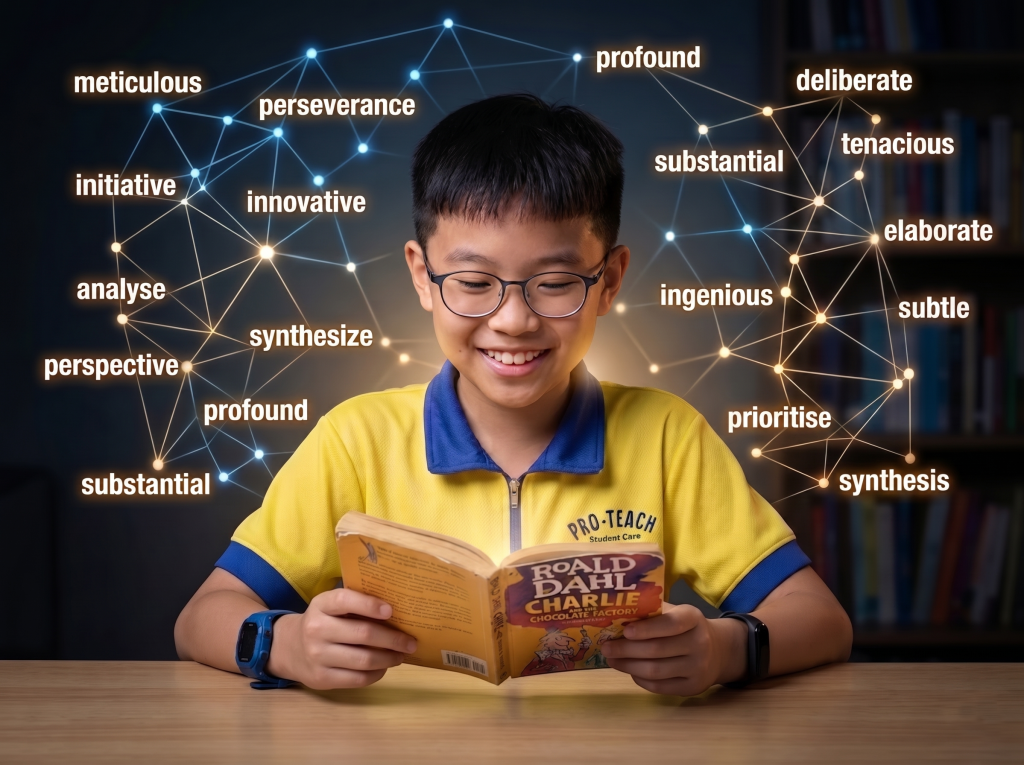
When children encounter a new word inside a story, they do not reach for a dictionary. They figure it out from the surrounding sentences, the character’s expression, and the tension in the scene. This is contextual learning, and it produces far deeper retention than memorising word lists ever could.
Research shows that children absorb up to 8–10 new words per day through reading. Direct vocabulary instruction, by comparison, introduces a fraction of that. The difference, compounded over a school year, is enormous.
Words learned in context stick. Words drilled from a list are forgotten.
Repetition Makes Words Familiar
Words encountered repeatedly become automatic. Children recognise them instantly, without effort, and that freed-up mental energy flows directly into comprehension, expression, and creativity.
This growing fluency also accelerates the pace at which children can absorb new material. The more they read, the faster they improve.
Books Unlock Words, Everyday Conversation, Never Will
Spoken language at home, in the playground, and even in the classroom draws from a relatively small pool of words. Books are different. They introduce children to vocabulary, phrases, and expressions that simply never appear in daily conversation.
Over time, these words become part of how children think and, crucially, how they write. A child who has met the word “melancholy” in a novel will reach for it in a composition. A child who has only ever heard “sad” will use “sad” every time.
Reading expands not just what children know but also how richly they can express it.
Exposure to Sentence Structures and Writing Styles
Seeing How Language Is Assembled
Reading teaches children how ideas are shaped into sentences, how a short, punchy line can create tension, and how a longer, flowing sentence can paint a picture. Through exposure to varied sentence lengths and structures, children develop an intuitive feel for rhythm and flow in writing.
This is not something that can be taught through grammar rules alone. It has to be felt, and it is felt through reading.
Three Writing Styles in One Bookshelf
Children who read across genres absorb multiple writing styles at once:
- Narrative writing from storybooks: character, plot, conflict, resolution
- Descriptive language from novels: sensory detail, vivid imagery, atmosphere
- Informational writing from non-fiction: clear structure, logical argument, factual precision
When they sit down to write a composition, a book report, or a creative piece, they have all three styles to draw from.
Smoother, More Connected Ideas
One of the most common weaknesses in primary school writing is choppy, disconnected prose ideas that do not flow naturally from one to the next. Reading resolves this organically.
Children see how skilled writers use transitions, vary their sentence openings, and build momentum across a paragraph. Without a single lesson on the subject, they begin to do the same.
Improving Spelling and Grammar Subconsciously
Spelling Through Sight, Not Just Sound
Children who read regularly develop a visual memory for words. They know instinctively when something looks wrong on the page, even if they cannot name the rule being broken.
This visual familiarity is one of the most reliable routes to spelling accuracy and, for many learners, far more effective than isolated spelling tests.
Grammar Absorbed, Not Memorised
A child does not need to identify a subordinate clause to write one correctly. Reading exposes them to well-structured sentences over and over again, and the patterns become instinctive.
Punctuation, capitalisation, paragraph breaks, and sentence variety are all absorbed through consistent exposure to well-written text. Children begin to write the way they read, and if they are reading good books, that is a very good thing indeed.
The child who reads widely often writes more naturally and accurately than the child who studies grammar rules in isolation.
Building Imagination and Idea Generation for Compositions
Stories Open Up Worlds
Every book a child reads is an invitation into a new world, with different cultures, time periods, characters, and challenges. This dramatically broadens their imaginative reference pool.
When it is time to write a composition, the well-read child has a vast internal library to draw from: plot structures, character types, vivid settings, and emotional arcs. The blank page is far less frightening when your imagination is full.
Learning to Build a Story
Reading shows children how stories are constructed, how tension is built, how characters are revealed, and how a satisfying ending earns its place. These are skills tested directly in PSLE composition writing, and children who have absorbed them through reading carry a genuine advantage.
Developing a Unique Writing Voice
Writers develop their voice by first absorbing the voices of others. Children who read widely experiment subconsciously with different styles and over time, something genuinely their own begins to emerge.
This is why two children with the same grammar score can produce compositions of wildly different quality. One has read widely; the other has not. The reader has absorbed personality, rhythm, and feeling from a hundred different authors. That richness shows up on the page.
Choosing Age-Appropriate Books for Primary 1–6
Matching books to a child’s reading level keeps them challenged without tipping into frustration. Here is a simple guide by level:
Primary 1 and 2: Make It Magical
Illustrated storybooks with simple, repetitive sentences
- Examples: Dr Seuss, Horrid Henry, early Roald Dahl
- Focus: Fun, phonics-friendly, picture-rich make reading feel like play, not work
Primary 3 and 4: Build the Habit
Chapter books with expanding vocabulary and multi-chapter story arcs
- Examples: Diary of a Wimpy Kid, Magic Tree House, The Famous Five
- Focus: Introduce new words naturally; longer narratives build concentration and comprehension stamina
Primary 5 and 6: Go Deeper
Longer stories with complex language, richer characters, and layered themes
- Examples: Percy Jackson series, The Giver, non-fiction aligned with Science and Humanities topics
- Focus: PSLE preparation vocabulary range, nuanced comprehension, diverse writing styles
Simple Ways Parents Can Build a Daily Reading Habit
The habit is everything. Here is how to build one that lasts:
- Set a fixed reading time of 15 to 20 minutes each day, at the same time: after school, before dinner, or before bed. Consistency matters more than duration.
- Create a comfortable reading space, a quiet corner, good light, and no screens nearby. The environment tells the brain it is time to focus and enjoy.
- Let children choose their books. Interest-driven reading is far more sustainable than assigned reading. A child who loves animals will read an animal book every single night.
- Read together as a family, parents who model reading send a powerful message: this is something worth doing. Take turns reading aloud. Make it shared.
- Talk about what they read, ask about characters, favourite moments, and surprising plot twists. Discussion deepens comprehension and turns reading into a conversation, not a chore.
The best reading habit is the one your child actually keeps.
Why Reading Daily Matters for Students
Daily reading is not just a pleasant pastime; it is a language engine. It builds vocabulary, sharpens writing instincts, strengthens spelling and grammar, and fires the imagination. The children who read consistently during their primary school years arrive at secondary school with a genuine, lasting advantage in English, in expression, and in confidence.
The best part? It does not require expensive resources or elaborate, structured lessons. It requires a good book, a quiet corner, and 15 minutes that you protect every day. That is it. That is the investment, and the return is a child who can read, write, and think with genuine skill and confidence.
At Pro-Teach, we bring that love of language to life every day through programmes like Expert English™ and Weaving Words™, designed to help primary school children develop a richer vocabulary and build powerful writing skills. Contact us today and discover how Pro-Teach can help your child become a more confident, more expressive reader and writer.