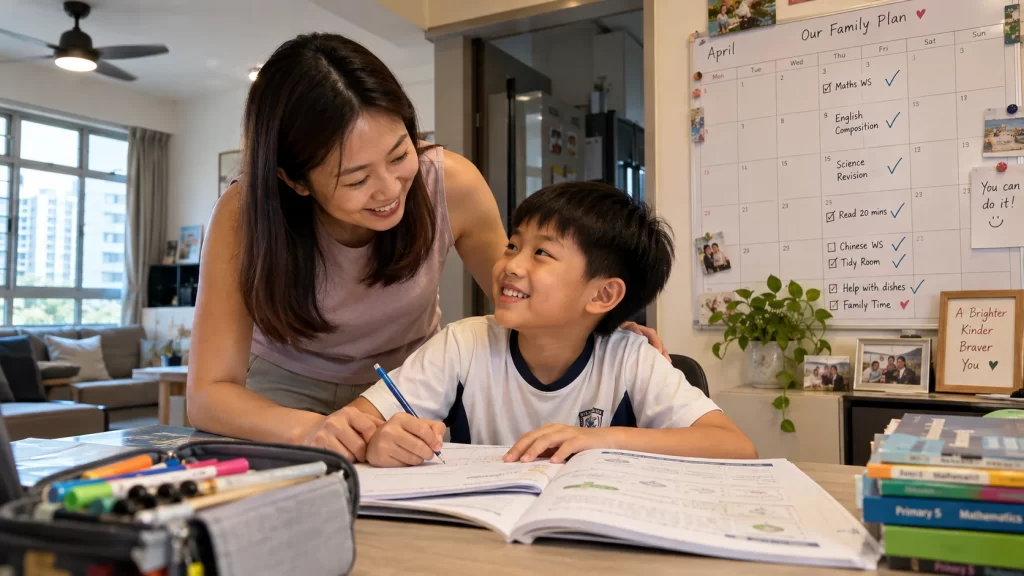
The weeks before PSLE have a way of making the whole household hold its breath. Revision piles grow, calendars fill up, and every parent privately wonders, “Are we doing enough?” The preparation matters as much in the last stretch as in the months behind it, but what it rewards is steadiness, not a frantic sprint.
The temptation to cram is real, especially when the clock feels loud. Yet a settled daily routine is far kinder to a Primary 6 pupil’s focus, mood and memory. Built into every afternoon, that routine means your son or daughter never has to face the final stretch alone.
This guide covers how to prepare for PSLE with a daily routine: why routine beats cramming, how to build a realistic PSLE revision schedule, how to ease PSLE stress, and what to do on the night before and morning of each paper.
Why Routine Beats Cramming in the Final Weeks Before PSLE
Late-night cramming feels productive because it feels urgent. But a tired, anxious mind takes in far less than a rested, settled one, and the stress that comes with a last-minute scramble can leave a child doubting what they already know.
A consistent daily structure does the opposite. It tells your child, again and again, that everything has its place and that there is time for it all. That dependability is a welcome counterweight to exam nerves.
Sleep, meals and rest are part of exam readiness, not a distraction from it. School-age children (6 to 13 years) need around 9 to 11 hours of sleep a day, which helps them stay alert, pay attention in class and learn better [1]. Regular, sufficient sleep also supports attention, learning and memory [2]. A pupil who protects their bedtime is, quite literally, protecting their revision.
A simple way to think about it:
- Sleep is when the day’s learning settles in
- Regular meals keep energy steady through long papers
- Short breaks keep concentration fresh rather than frayed
Why Daily (Not Occasional) Support Matters Most Right Now
There is a world of difference between help that appears now and then and support that turns up every single day. Ad hoc help tends to arrive after a problem has already surfaced: a weak topic discovered the night before a paper, or a slipping habit noticed too late.
Daily support gives teachers more chances to spot a gap early. When revision is supervised and guided each afternoon, small gaps are more likely to surface while there is still plenty of time to close them, rather than during exam week.
That is the gap Pro-Teach’s structured daily support is built to close: supervised afternoons where homework is guided as it happens, with revision sessions at our community-based centres, so help becomes part of the everyday landscape instead of something reached for only once worry has already set in.
Building a Realistic Daily PSLE Revision Schedule
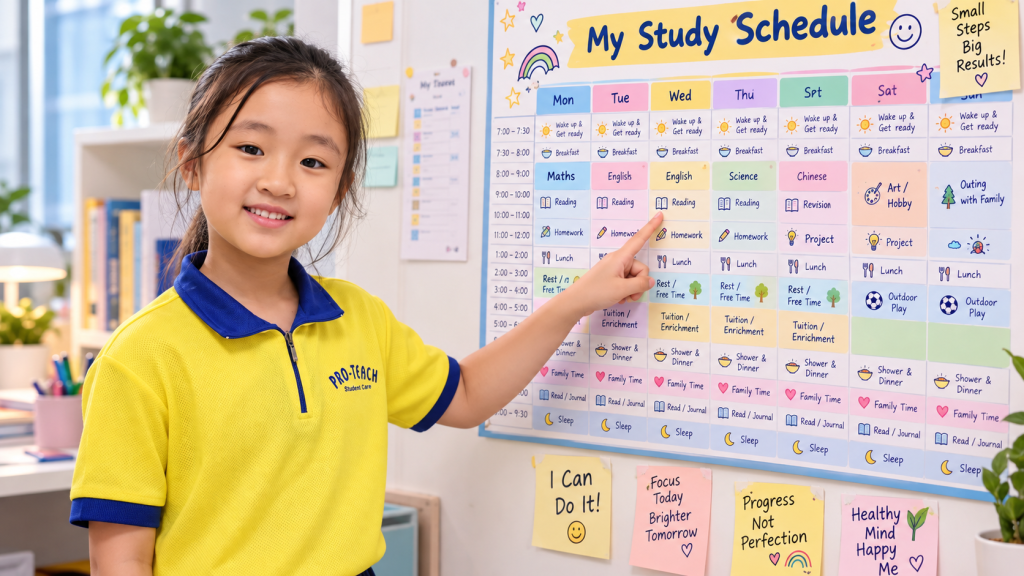
A realistic schedule is one your child can actually follow, tired days included. Aim for balance, variety and breathing space.
Start by knowing the shape of the exam period. In recent years the oral examinations and listening comprehension papers have come before the written papers, which then run over about a week [3]; the dates change from year to year, so check SEAB’s current examination calendar. Each subject is graded on an Achievement Level (AL) scale from AL1 to AL8 [4]. The PSLE Score adds the subject results together, ranging from 4 to 32 [5]. A good PSLE revision schedule gives oral and listening practice its own place early on, rather than leaving it to the last minute.
Spread the subjects. Rotate English, Mathematics, Science and Mother Tongue across the week so no subject is left to gather dust. Give a little extra time to the topics your child finds trickiest, and keep one lighter session for subjects they already feel good about.
Choose short, focused blocks. For primary school children, shorter, focused blocks, each followed by a brief pause, are often easier to sustain than a long, unstructured stretch at the desk. Many children find that short bursts keep their attention fresh.
Leave room to recharge. Build in genuine downtime: a walk, a snack, a chat, and some free play. Rest between papers is what lets the next hour count.
A sample afternoon might look like this:
- Settle in, snack, and have a short wind-down
- One focused revision block on a priority subject
- A short break to stretch and refuel
- A second block on a different subject
- Free time and an early, relaxed evening
Managing PSLE Exam-Day Nerves
Some nerves are perfectly normal, and a little adrenaline can even sharpen attention. But it helps to recognise when PSLE stress is taking over. Common signs of exam anxiety in primary school children include:
- Tummy aches or headaches with no clear cause
- Trouble falling asleep, or restless nights
- Irritability, tearfulness or sudden clinginess
- Avoiding revision or saying “I can’t do it”
If you spot these, stay gentle and curious. Simple calming habits that parents and teachers can reinforce together include slow, even breathing (in for four counts, out for four), a short stretch between study blocks, and a favourite reassuring phrase such as “I’ve done the work, and I’ll do my best.” If these signs persist or worsen, speak to your child’s school counsellor or a GP. Pro-Teach’s guide to helping your son or daughter curb exam stress offers more ideas to try at home.
Above all, keep perspective. Effort and consistency matter far more than any single score. A child who feels valued for trying hard walks into the exam hall with a lighter heart, and a lighter heart thinks more clearly. As ever, every child responds differently, and results vary by student.
The Night Before and Morning of Each PSLE Paper
A set routine on exam days reduces last-minute panic, because there is simply less to decide. These PSLE exam tips work best when settled in advance: settle the plan once, and the morning runs itself.
The night before:
- Pack the bag together: stationery, water bottle, and any items the school has requested
- Lay out the uniform and check the travel plan
- Do a light skim of key notes only, then close the books
- Aim for an easy dinner and an early bedtime
What to avoid:
- Introducing brand-new topics
- Late-night marathon revision
- Comparing your child with classmates or discussing “what if” scenarios
The morning of:
- Wake at the usual time, with a proper breakfast
- Leave early enough that nobody is rushing
Keep your encouragement simple and warm. Try “I’m proud of how hard you’ve worked” in place of “Make sure you do well.” The first gives your child confidence to lean on; the second can feel like something extra to carry.
How Structured Student Care Supports This Period
For many Singapore families, the hours after school are the trickiest part of the day. Parents are at work, energy is dipping, and revision needs a guiding hand. This is where student care in Singapore, and good after-school care in Singapore, can make a real difference.
At Pro-Teach, our community-based student care centres offer consistent daily supervision, with homework guidance and academic tuition and exam revision sessions as part of the care package. Our school-based centres focus on homework supervision, so it is worth asking which support your nearest centre provides. Children sit down in a welcoming space, surrounded by friendly teachers and classmates, and see the same faces day after day, which makes asking for help feel natural rather than daunting.
Because the routine stays the same from day to day, there is no extra stress to absorb at the busiest time of the year. Children who would otherwise be on their own after school are guided gently through homework, revision blocks and rest, in an environment that feels like a second home.
Depending on the centre, our core academic programmes sit alongside school learning, so the support your child receives stays in step with the classroom. Expert English™ is built on the MOE syllabus, while Mighty Math™ and Super Science™ cover mathematics and science and are likewise designed around it. With decades of experience as a student care and tuition centre in Singapore and 27+ locations across Singapore in the North, Central, West, and East, there is likely a centre close to your home or your child’s school.
Every child is different, and results vary by student. What a reliable, supportive routine can do is give your child settled, confident conditions in which to show what they know.
Frequently Asked Questions
How many hours should my child study a day before PSLE?
There is no single right number, because it depends on a pupil’s age, energy and the work the school has set. What matters more is the shape of the day: a couple of short, focused blocks on different subjects, each followed by a break, with sleep protected, as in the sample afternoon above. If you are unsure, ask the class teacher what extra revision suits your son or daughter right now.
Should my child revise the night before a PSLE paper?
A light skim of key notes is fine, then close the books. A rested mind usually serves a pupil better than another hour of notes, so pack the bag together, lay out the uniform and aim for an early bedtime.
How can I tell if my child is stressed about PSLE?
Look for tummy aches or headaches with no clear cause, trouble sleeping, irritability, tearfulness or clinginess, and avoiding revision or saying “I can’t do it”. If they persist or worsen, a conversation with the school counsellor or a GP is the right next step.
Consistency Is the Strongest Preparation for the Final Stretch.
The final stretch before PSLE is not about squeezing in new content. It is about protecting sleep, keeping revision steady, and helping your child feel calm, capable, and cared for. Every child’s exam experience looks different, and that is perfectly normal. What they will remember is that someone was there, every day, cheering them on.
Explore Pro-Teach’s programmes to see how structured daily support works. Contact us today to learn how Pro-Teach can help your child thrive.
References
- Health Promotion Board (HealthHub), “Why Is Sleep Important for Kids?,” https://www.healthhub.sg/live-healthy/should-kids-sleep-in-when-schools-out
- American Academy of Sleep Medicine, “Child Sleep Duration Health Advisory,” https://aasm.org/advocacy/position-statements/child-sleep-duration-health-advisory/
- Singapore Examinations and Assessment Board (SEAB), “PSLE,” https://www.seab.gov.sg/psle/
- Singapore Examinations and Assessment Board (SEAB), “National Examinations’ Grading System,” https://www.seab.gov.sg/newsroom/national-examinations–grading-system/
- Singapore Examinations and Assessment Board (SEAB), “About PSLE,” https://www.seab.gov.sg/psle/about-psle/