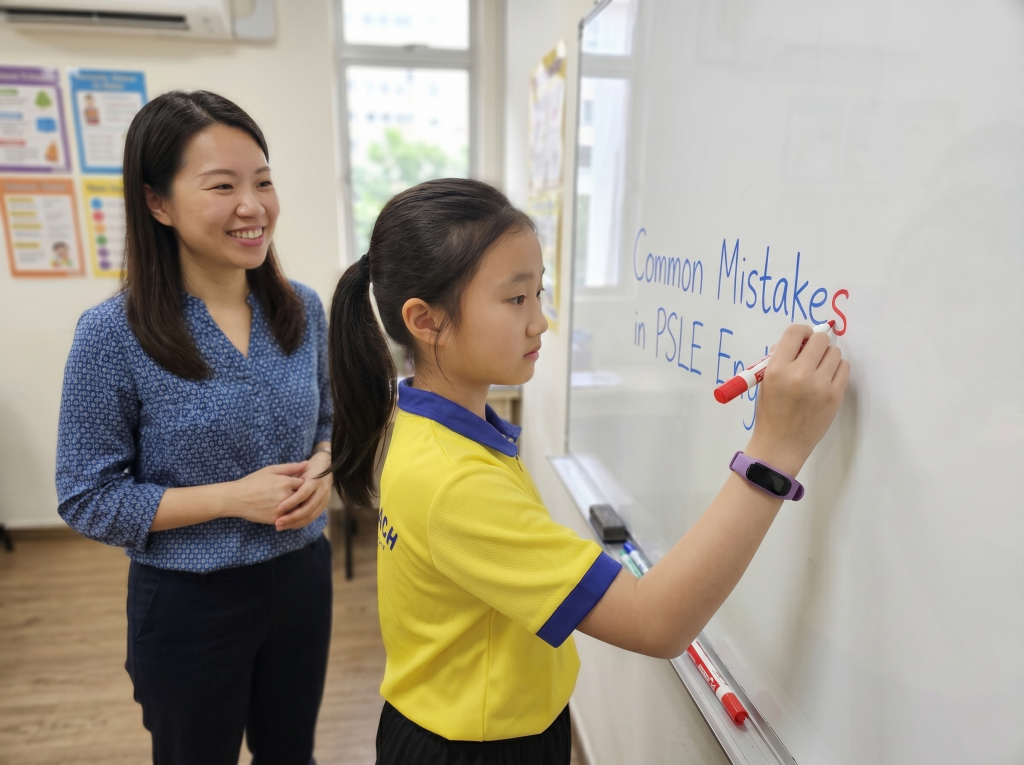
English is more than just one subject on the Singapore primary school timetable. For the PSLE, it carries the weight of four separate papers: Writing, Language Use and Comprehension, Listening Comprehension, and Oral Communication. A strong result opens doors; a weak one can hold a child back, regardless of how brilliantly they perform in every other subject.
Yet many parents find that even children who read widely and speak confidently still trip over the same PSLE English common mistakes year after year. The good news? These mistakes are predictable, and with the right support, entirely correctable.
Why Singapore Children Struggle with Primary PSLE English
The PSLE English syllabus tests a wide range of skills simultaneously: grammar accuracy, composition structure, comprehension inference, vocabulary range, and spoken fluency. Each paper rewards a different kind of thinking, which means a child who is strong in one area can still be caught off guard by another.
The British Council and Singapore’s MOE have long emphasised that primary English is not just about memorising grammar rules; it is about applying language with confidence and purpose. That gap between knowledge and application is exactly where most children lose marks.
PSLE English Common Mistakes:
Mistake 1: PSLE Composition Feels Flat
The most costly PSLE English common mistake in Paper 1 is a predictable three-part pattern: a flat opening (“One fine day…”), a crisis that lacks emotional depth, and an ending that resolves everything in two rushed sentences.
Examiners reward originality and control. A compelling opening places the reader in the middle of a moment; a well-built crisis shows cause, consequence, and character; a strong ending circles back with meaning. Children who practise composition writing with guided feedback, as in Pro-Teach’s Expert English™ and Weaving Words™ programmes, learn to break these habits systematically rather than repeating them under exam pressure.
Mistake 2: Using Grammar That Quietly Drain PSLE English Scores
Inconsistent tense and subject-verb errors are the two grammar rules that cost primary school students the most marks, not because children don’t know the rules, but because they lose track of them mid-sentence.
Tense confusion often appears in compositions where a child shifts between past and present without realising it. Subject-verb errors (“The group of students are…” instead of “is”) reflect rushing rather than ignorance. Regular, structured grammar practice with immediate correction, especially under timed exam conditions, is the most effective fix.
Mistake 3: Not Going Beyond Basic Comprehension
Comprehension is where many children score poorly despite understanding the passage. The mistake is lifting long passages from the text verbatim instead of selecting the precise evidence that answers the question.
Examiners want students to show they have processed the information, not simply located it. Teaching children to identify question types (inference vs. literal retrieval vs. vocabulary-in-context) and match their answer strategy accordingly is a skill that must be explicitly taught, practised, and refined over multiple practice sessions.
Mistake 4: Weak Vocabulary
Over-reliance on “said”, “went”, “nice”, and “happy” limits your child’s ability to express nuance, and nuance is what separates a Band 1 composition from a Band 3. Swapping familiar words for random “bombastic” vocabulary can backfire, though, if the phrases are used out of context.
Your child’s learning journey in vocabulary should focus on range and accuracy together. That means building personal word banks organised by theme, practising new words in sentences before using them under pressure, and understanding subtle differences in connotation: for example, the difference between “apprehensive” and “terrified”.
Mistake 5: Underperforming in Oral Despite Knowing the Answers
The Oral Communication paper tests two things: Reading Aloud and Stimulus-Based Conversation. Both reward children who engage expressively, yet many students read in a flat monotone and answer conversation questions with the minimum possible words.
For Reading Aloud, the fix is consistent practice with attention to punctuation cues: pauses, rising intonation at questions, and controlled pace. For Conversation, children need to learn to extend their answers with reasons and examples rather than closing down the exchange. You can make a measurable difference at home by practising short read-aloud sessions and asking open-ended follow-up questions during everyday conversation.
Beyond Good Intentions: What Effective PSLE English Preparation Looks Like
The best preparation for PSLE English is not a last-minute sprint; it is consistent, low-pressure practice woven into your child’s everyday routine:
- Read together daily: even 15 minutes of shared reading builds vocabulary and deepens comprehension naturally.
- Have conversations with depth: ask, “Why do you think that?” to cultivate the reasoning habits that oral examiners reward.
- Review marked compositions: error patterns reveal exactly where to focus; repeat mistakes signal a skill gap, not laziness.
- Choose structured support early: student care centres with dedicated English programmes give children regular, guided practice in all four papers, not just the components they enjoy.
For over 27 years, Pro-Teach has been helping families across 27+ locations in Singapore bridge exactly these gaps. The Expert English™ and Weaving Words™ programmes develop confident writers, precise grammarians, and expressive speakers through a structured learning journey that runs alongside student care, six days a week.
Give Your Child the English Edge They Need for PSLE
The five PSLE English common mistakes outlined above are the ones tutors, teachers, and examiners see most often, which means they are also the most correctable. Early, targeted support makes the difference between a child who dreads English papers and one who walks into the exam room prepared and confident.
Help your child overcome these common PSLE English mistakes. Contact us for expert academic support.